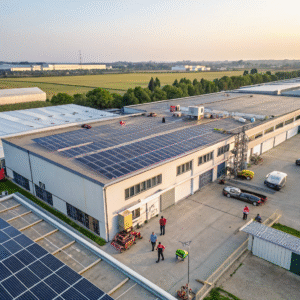
From DC to AC: How Inverters Power Your Business (and the Grid)?
Ever wondered how that solar panel on your roof actually powers your coffee machine? The secret lies in a humble but powerful device called an inverter.
Inverters convert DC electricity from solar panels or batteries into usable AC power for your business and the grid, enabling energy independence and efficient power distribution.

But inverters do much more than just convert current - they're the brains behind your energy system. Let's explore how choosing the right inverter can transform your power infrastructure.
The Grid-Tied vs. Off-Grid Debate: How Inverter Choice Impacts Your Energy Independence?
Power outages got you frustrated? Your inverter choice could be the difference between darkness and business-as-usual during grid failures.
Grid-tied inverters sync with utility power for net metering benefits, while off-grid inverters with battery backup1 provide complete energy independence - your choice depends on reliability needs versus cost savings.
Understanding the Core Differences
| System Type | Power Source | Battery Required | During Outages | Best For |
|---|---|---|---|---|
| Grid-Tied | Solar + Grid | No | Shuts down | Cost-conscious users |
| Hybrid | Solar + Grid + Battery | Yes | Keeps running | Balanced approach |
| Off-Grid | Solar + Battery | Yes | Always on | Remote locations |
I remember consulting with a rural clinic that absolutely needed 24/7 power for medical equipment. For them, the higher upfront cost of an off-grid system with battery backup was non-negotiable. Meanwhile, an urban retail store opted for grid-tied to maximize their net metering benefits2.
Key Considerations for Your Business
- Reliability Requirements: Hospitals or data centers need uninterrupted power
- Local Regulations: Some utilities restrict grid-tied systems
- Budget: Off-grid systems cost 20-30% more due to battery requirements
- Future Expansion: Hybrid systems offer the most flexibility
The truth is there's no one-size-fits-all solution. I've seen clients save thousands by properly matching their inverter choice to their actual needs rather than following trends.
Optimizing Your Energy Harvest: Understanding Maximum Power Point Tracking (MPPT)3 in Inverters
Why settle for 80% when you could get 99% from your solar panels? That's where MPPT technology shines.
MPPT is an intelligent tracking system in quality inverters that constantly adjusts to extract maximum available power from solar panels, typically boosting energy harvest by 15-30% compared to basic inverters.
How MPPT Works Its Magic
- Continuous Monitoring: Scans panel output 100+ times per second
- Dynamic Adjustment: Finds the ideal voltage/current combination
- Weather Adaptation: Compensates for cloudy conditions or partial shading
I recall testing two identical solar arrays side-by-side - one with MPPT and one without. Over a month, the MPPT system generated 22% more energy. For a medium-sized business, that difference could mean thousands in annual savings.
Choosing the Right MPPT Solution
- Single vs Dual MPPT: Larger systems benefit from multiple trackers
- Efficiency Ratings: Look for 98%+ conversion efficiency
- Voltage Range: Wider ranges handle more panel configurations
Pro Tip: Don't just look at peak efficiency numbers - examine the inverter's performance across different operating ranges. Some models maintain high efficiency better under partial load conditions.
Seamless Integration: How Inverters Connect Your Solar Array to Storage and the Grid
Modern inverters do far more than convert current - they're the central nervous system of your energy ecosystem.
Advanced inverters intelligently manage power flow between solar panels, batteries, and the grid, enabling features like time-of-use optimization, emergency backup, and grid services participation.
The Integration Advantage
- Battery Compatibility: Works with multiple storage technologies
- Smart Energy Management: Prioritizes solar self-consumption
- Grid Services: Can provide voltage regulation and frequency response
I recently worked with a manufacturing plant that used their inverter's advanced controls to shift energy usage patterns, reducing demand charges by 18%. The inverter automatically:
- Stored excess solar in batteries
- Dispatched stored energy during peak rate periods
- Maintained critical loads during outages
Future-Proofing Your Investment
When selecting an inverter, consider:
- Communication Protocols: MODBUS, SunSpec, etc.
- Software Integration: Compatibility with energy management systems4
- Scalability: Ability to add more panels or batteries later
The most sophisticated inverters today can even participate in virtual power plants, creating potential revenue streams for your business.
Conclusion
Inverters transform raw solar energy into usable power while enabling energy independence5, maximum efficiency, and smart grid integration - making them the cornerstone of modern energy systems.
Understand the critical role of battery backup in ensuring uninterrupted power supply. ↩
Learn how net metering can provide financial benefits for businesses using solar energy. ↩
Find out how MPPT technology can significantly boost your solar energy output. ↩
Explore how energy management systems can optimize your energy usage and costs. ↩
Explore how energy independence can enhance your business's resilience and reduce costs. ↩