Home & EV Harmony: Unlocking Seamless Electric Vehicle Charging with Integrated Battery Storage?
Struggling with high EV charging costs and grid dependency? Imagine powering your electric vehicle efficiently while slashing your electricity bills.
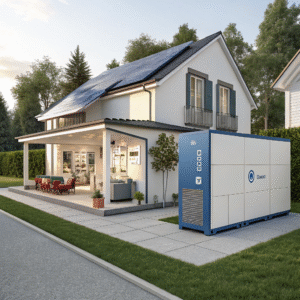
Integrated home battery storage1 enables EV owners to charge vehicles using stored off-peak energy2, reducing costs by 40-60% while providing backup power during outages.
The synergy between home batteries and EV charging isn't just futuristic—it's a practical solution available today. Let's explore how this integration works and why it's revolutionizing home energy management.
Charge Your EV for Less: Leveraging Off-Peak Power with Integrated Home Battery Storage?
Why pay peak rates when your car could charge for half the cost while you sleep?
Home battery systems store inexpensive off-peak grid energy (typically 8¢-12¢/kWh vs. 30¢+ peak rates), enabling EV charging at optimal times while avoiding demand charges.
The Economics of Time-Shifted Charging
Integrated systems use smart algorithms3 to:
- Price arbitrage: Buy/store energy when cheapest (usually 11PM-6AM)
- Load shifting: Discharge during high-rate periods (4PM-9PM)
- Demand charge avoidance: Prevent short-term power spikes that trigger commercial-style fees
| Strategy | Typical Savings | Best For |
|---|---|---|
| Off-peak charging | 50-70% | All EV owners |
| Solar pairing | 70-90% | Sunbelt homes |
| V2H (vehicle-to-home) | 30-50% | Outage-prone areas |
California's PG&E territory shows the stark difference:
- Peak rate: $0.48/kWh
- Off-peak with battery: $0.12/kWh
(Source: CPUC 2023 rate schedules)
Your Home's Personal Charging Station: Convenience and Control with Integrated Battery Cabinets?
Tired of competing for public chargers or worrying about circuit overloads?
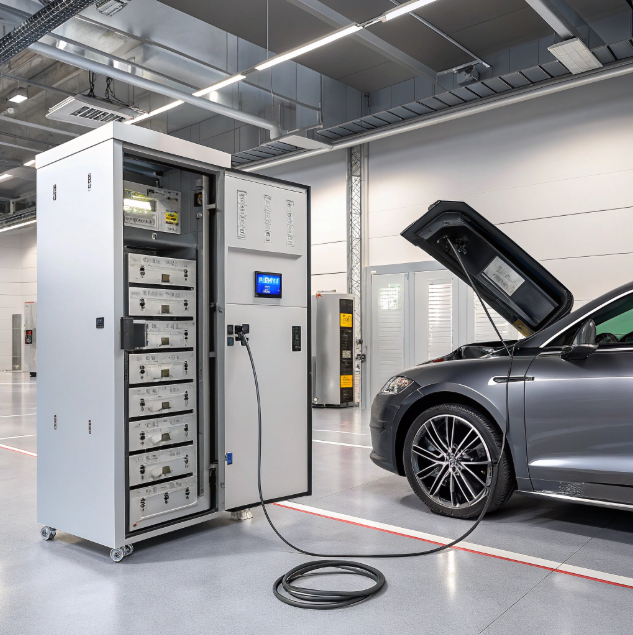
Integrated battery cabinets provide dedicated 240V/48A charging (11-15kW) without panel upgrades, adding 30-50 miles per hour while protecting home electrical systems.
Technical Implementation Deep Dive
Modern systems solve three critical challenges:
1. Electrical Capacity Management
- Smart current sharing between home loads and EVSE
- Automatic throttling during dryer/oven use (NEC 625.42 compliant)
2. Space Optimization
- Wall-mounted designs (e.g., Tesla Powerwall + Wall Connector)
- All-weather outdoor-rated enclosures
3. Future-Proofing
- Bidirectional charging readiness (CCS ISO 15118-20)
- 19.2kW capability for Cybertruck/Silverado EV
Pro Tip: Look for UL 9540-certified systems with at least 10kWh capacity—sufficient for daily commutes under 50 miles.
The Next Frontier in Home Energy: Integrating EV Charging into Your Smart Battery Cabinet?
What if your EV could power your home during blackouts while earning grid rewards?
Vehicle-to-home (V2H)4 integration turns EVs into 100kWh+ backup power sources, with emerging systems like Ford Intelligent Backup Power providing 3-7 days of essential home loads.
V2H Implementation Pathways
Current Options:
-
DC-coupled systems (e.g., Ford Charge Station Pro)
- Pros: Higher efficiency (93% vs AC's 85%)
- Cons: $5k-$8k additional hardware
-
AC-coupled solutions (e.g., Wallbox Quasar 2)
- Pros: Works with any CCS EV
- Cons: 15-20% conversion losses
2024 Game Changers:
- Tesla's Universal Wall Connector (rumored V2H support)
- SAE J3068 standardization for 19.2kW AC systems
Financial Incentives:
- 30% federal tax credit (IRA Section 25C)
- CA SGIP rebates up to $1,000/kWh
Conclusion
Integrated battery-EV systems transform homes into resilient energy hubs, delivering cheaper charging, backup power, and grid services—all while future-proofing for bidirectional capabilities.
Explore how integrated home battery storage can significantly reduce your EV charging costs and provide backup power. ↩
Learn about the advantages of using off-peak energy to charge your EV and save on electricity bills. ↩
Find out how smart algorithms can enhance your EV charging efficiency and reduce costs. ↩
Discover how V2H technology can turn your EV into a backup power source for your home. ↩