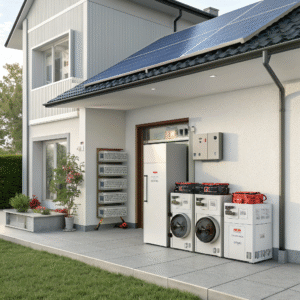
Silent Power, Secure Home: How Battery Backup with Solar Keeps Your Appliances Running Through Any Outage?
Power outages leave you frustrated, vulnerable, and disconnected. Imagine losing food, security systems, and communication when you need them most. Solar battery backup1 eliminates this nightmare completely.
Solar battery backup systems store excess solar energy during the day, automatically powering your home during outages. This seamless transition keeps essential appliances running, from refrigerators to security systems, ensuring uninterrupted comfort and safety regardless of grid failures.

The peace of mind that comes with energy independence2 is priceless, but the technical details and financial benefits run much deeper than most homeowners realize.
Inflation-Proof Your Home: Why Generating Your Own Power is the Ultimate Financial Security Against Rising Energy Prices?
Energy bills skyrocket while your income stays flat. Traditional power costs devour your budget with no end in sight. Solar generation shields you from this relentless inflation.
Home solar systems lock in your energy costs for 25+ years, protecting against utility rate increases that average 2-3% annually. With fixed monthly payments often lower than current electricity bills, you gain predictable expenses while building equity through energy independence.
Think of solar as purchasing decades of electricity upfront at today's prices. While your neighbors face endless rate hikes, your energy costs remain frozen in time. The average American household spends $1,500+ annually on electricity, but these costs compound dramatically over time. Consider this comparison:
| Timeline | Grid Electricity (3% annual increase) | Solar System Cost |
|---|---|---|
| Year 1 | $1,500 | $1,200 |
| Year 10 | $2,015 | $1,200 |
| Year 25 | $3,139 | $1,200 |
| Total | $52,000 | $30,000 |
This protection becomes even more valuable during economic uncertainty, when utilities often seek emergency rate increases to cover infrastructure costs.
Beyond Eco-Friendly: The Pure Economic Advantage of Home Solar in High-Sunshine Regions?
Environmental benefits sound nice, but they don't pay bills. High-sunshine regions offer pure profit potential that makes solar a business decision, not charity work.
Homes in high-sunshine regions3 generate 40-60% more solar energy than national averages, creating faster payback periods and higher returns on investment. Arizona, California, and Nevada residents often see 6-8 year payback periods with 15-20% annual returns thereafter.
Geography determines your solar profitability more than any other factor. High-sunshine regions receive 5-7 peak sun hours daily compared to 3-4 hours in cloudier climates. This translates directly into kilowatt-hour production and dollar savings.
Regional advantages include:
- Net metering policies: Sell excess power back to utilities at retail rates
- State incentives: Additional tax credits and rebates stack with federal programs
- Property value increases: Solar homes sell 4-6% higher than comparable properties
- Reduced cooling costs: Solar panels provide roof shading, lowering air conditioning needs
The financial mathematics become compelling when you realize that each kilowatt of solar capacity in Phoenix produces roughly 1,800 kWh annually, compared to 1,200 kWh in Seattle. This 50% production difference means dramatically faster investment recovery and lifetime savings.
From Rooftop to Refrigerator: Powering Every Aspect of Your Life with Clean, Abundant Solar Energy?
Solar panels seem disconnected from daily life. But modern systems integrate seamlessly, powering everything from morning coffee to electric vehicle charging throughout your home.
Modern solar installations power entire households, including HVAC systems, electric vehicle chargers, pool pumps, and all appliances. Smart inverters and battery systems automatically prioritize critical loads during outages while optimizing energy usage for maximum savings during normal operation.
Today's solar installations function as complete energy ecosystems rather than simple panel arrays. Smart home integration allows you to monitor and control energy flow in real-time, automatically shifting non-essential loads to peak production hours.
Your system intelligence includes:
- Load prioritization: Critical systems (refrigeration, medical devices) receive power first during outages
- Time-of-use optimization: Heavy appliances run during peak solar production hours
- Grid integration: Excess power flows back to utilities for credit during surplus periods
- Weather forecasting: Systems pre-charge batteries when storms approach
Electric vehicle integration represents the ultimate synergy—your roof powers your transportation, eliminating both electric and gasoline expenses. A typical EV requires 3-4 kW of solar capacity for daily driving needs, easily accommodated by modern residential systems.
Conclusion
Solar battery backup1 transforms your home into an energy-independent fortress, protecting against outages while building long-term financial security through predictable, inflation-proof power generation.